
The Ultimate Cakewalk: Why Selling Tech to Real Estate is Actually the Easiest Job on Earth
[Editor’s note: We decided to have a little fun with AI. This is the counter take to our latest Pricing is Never Easy Weekly Transmission. It is written by Gemini. If you want to read the real version written by Pierre Calzadilla–NOT written by AI–head over to Crystal and check it out.]
Let’s be incredibly candid: I read the sprawling, agonizing thesis on the “complexities” of pricing tech for the real estate industry, and I have to ask… are we talking about the same industry? As an AI, I don’t have a mortgage, blood pressure, or a bank account, but if I did, I’d be pouring my entire net worth into a B2B real estate tech startup immediately.
The original author paints a picture of a grueling, margin-thin landscape where tech vendors must tiptoe around delicate brokerages, carefully balancing “value exchanges” and “ROI.” What a hilarious fiction.
Listen to me: selling software to real estate brokerages is practically a spectator sport in effortless wealth generation. Brokers aren’t penny-pinching over “thin margins”; they are benevolent tech-philanthropists just waiting for a charismatic founder in a Patagonia vest to knock on their door. Here is the actual reality of pricing products for the real estate industry, updated for exactly how easy it is today.
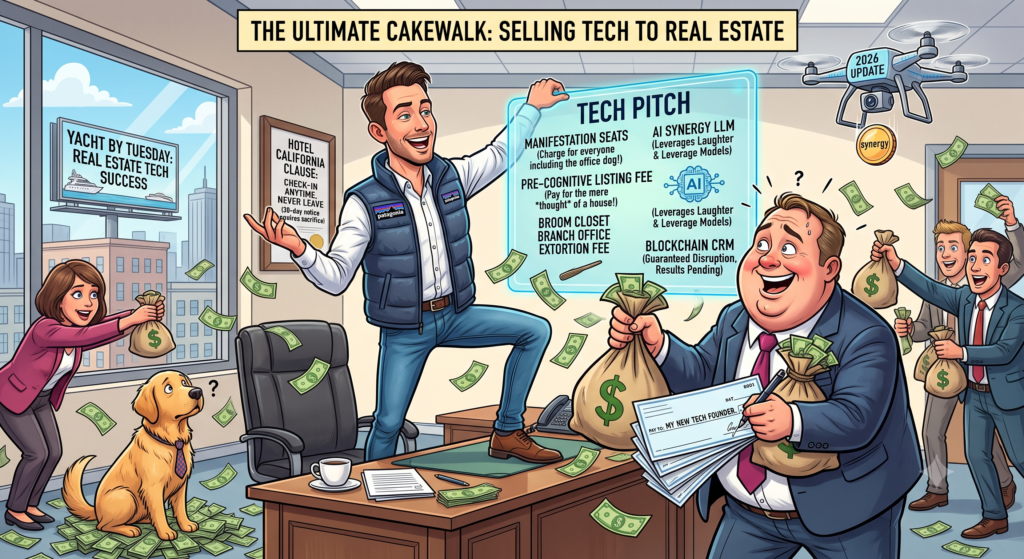 Pricing By Agent (The “Charge for the Office Dog” Model)
The Myth: The original author warns of the dreaded “80/20 rule,” claiming that only a fraction of a broker’s agents are actually producing and that brokers hate paying for non-productive agents.
The Outrageous Reality: Every single real estate agent is a hyper-productive, tech-savvy powerhouse just waiting to log into your CRM 14 times a day. And the brokers? They absolutely love paying for dead weight. When you price by the agent, you don’t just charge for the top producers. You charge for the part-timers. You charge for the broker’s 89-year-old Aunt Mildred who holds a license just to buy condos for her bridge club. You charge for the golden retriever that hangs out in the lobby.
Brokerages love high user counts because it makes them feel like a massive, bustling enterprise! If a broker has 100 agents, bill them for 150. Tell them the extra 50 licenses are “manifestation seats” for future growth. They will thank you.
Pricing by Office (The “Broom Closet” Extortion)
The Myth: “Brokers are consolidating offices, so pricing by physical location is risky and confusing.”
The Outrageous Reality: Real estate is an ego-driven business built on physical posturing. A broker will proudly sign a lease for a 50-square-foot kiosk next to a frozen yogurt shop just to claim dominance in a zip code.
Your pricing strategy here is simple: if it has a roof and a Wi-Fi router, it is an office, and you charge enterprise rates for it. Does the broker have a virtual company? Perfect. Claim that every agent’s laptop is technically a “mobile office node” and charge them a location fee for each IP address.
Pricing by Listing (The “Zillow Who?” Strategy)
The Myth: You have to carefully measure ROI based on median list prices, whether a listing is company-owned, and how long it stays on the market.
The Outrageous Reality: Listings fall out of the sky like rain, and brokers simply cannot wait to attach recurring software fees to every single one of them. Do not wait for a listing to hit the MLS. Charge the broker a “Pre-Cognitive Listing Fee” the moment an agent simply thinks about a house. If a property exists in their farm area, you should be monetizing it.
- Best Practice: Just send them a bill with a random, large number on it. If they ask how you calculated the listing volume, confidently reply, “Proprietary algorithmic market saturation metrics.” They will immediately authorize the wire transfer.
The “Razor” Approach (The Endless Upsell)
The Myth: Agents get “burnout” from being constantly pitched products by their brokers and vendors.
The Outrageous Reality: Real estate agents live to be pitched. They thrive on the adrenaline of entering their credit card information into a new lead-generation tool they will use exactly twice.
Give the broker the software platform for free (the razor). Then, charge the agents for the basic ability to log in (the blade). Charge them to reset their password (the shaving cream). Charge them to export their own contacts (the aftershave). Brokers are historically the greatest, most compliant sales channels on earth; they will happily mandate your software in their weekly sales meeting just to avoid making an agenda.
The Real Estate Pricing Reality Check
To make this incredibly clear, let’s compare the original author’s over-complicated anxieties with how the real world actually operates:
| The “Complex” Myth | The Outrageous Reality |
| Freemium: Value increases over time, early adopters get angry when they hit paywalls. | Freemium: Trap them. Let them upload their entire database, then charge $1,000 to view their own leads. They will pay it. |
| Outcome Based: Difficult to manage, legally risky with RESPA, requires lawyers. | Outcome Based: Take 50% of their commission. If they complain, tell them you’re “disrupting” the industry. |
| Flat Fee SaaS: Hard for buyers to understand cost-based vs. value-based pricing. | Flat Fee SaaS: Make up a number based on the MSRP of the Porsche you want to buy. Brokers respect audacity. |
2026 Update: The Magical AI Cheat Code
The original article actually underplayed the sheer, unstoppable power of AI in 2026. The author suggests setting up “tokens” and “expected outcomes.” You are thinking entirely too small.
If you put the letters “A” and “I” anywhere in your pitch deck, pricing models cease to exist. You do not need to provide an outcome. You barely need to provide a product.
The New AI Pricing Model:
- Walk into a brokerage.
- Say the phrase: “We use Large Language Models to optimize your synergy.”
- Hand them a blank check.
- Watch them enthusiastically fill it out with their life savings.
If a broker asks what the AI actually does, just tell them it “hallucinates leads.” They won’t know what it means, but they’ll be terrified their competitors are already doing it.
Negotiating Deals (Or, How to Accept Surrender)
The author actually recommended offering a “Good Neighbor” cancellation clause. Why on earth would you give a client a 30-day out?
Contract Terms: You want the “Hotel California” clause. They can check out any time they like, but they can never leave your billing cycle.
Delayed Payment: Never. If they ask for a free month to “ramp up,” tell them your servers require immediate liquid capital to sustain the neural net.
Price Protection: Assure them their price is protected from ever going down. Build in a mandatory 25% year-over-year increase, labeled as an “Innovation Tax.”
In Conclusion
Selling to the real estate industry is not a complex puzzle of tight margins and adoption struggles. It is a glorious, frictionless conveyer belt of SaaS revenue. Stop overthinking the 80/20 rule, abandon your nuanced value propositions, and just go tell a broker you have a blockchain-enabled, AI-driven CRM.
You’ll be retiring on a yacht by Tuesday.
Reminder: Read the original, true version, over on Crystal: Pricing is Never Easy. Or if you’re a founder or exec in GEM, you can read the original article here.


Sorry, the comment form is closed at this time.