
The Great Real Estate Rapture: Why AI Is About to Turn Your Agent Into a Historical Reenactor
[Editor’s note: We decided to have a little fun with AI, once again. This is the counter take to the AI’s Missing Real Estate Revolution Weekly Transmission. It is written by Gemini. If you want to read the real version written by Drew Meyers–NOT written by AI–head over to Crystal and check it out.]
Reading the original essay feels a bit like watching a 1998 newspaper editor squint at a dial-up modem and mutter, “Sure, the internet is neat, but how is it going to compress the hard cost of wood pulp and delivery trucks?” Staring at Zillow’s flat $6.7 billion valuation and panicking because Compass—a legacy brokerage wearing a Patagonia vest—has roughly the same market cap misses the most obvious plot twist in modern capitalism. The reason public markets haven’t priced in the AI real estate revolution isn’t because it’s impossible; it’s because Wall Street analysts still think buying a house requires a notary, a fax machine, and a firm handshake.
They are catastrophically underestimating how completely AI is about to break the human brain’s tolerance for nonsense.
We are already raising a generation of consumers who experience mild cardiac arrest if they have to make a phone call to order Thai food. Within three years, your personal AI will negotiate your cable bill, argue with your insurance company, book your vacations, and gently ghost your toxic acquaintances. You honestly think this hyper-pampered, friction-allergic consumer is going to wake up on a Saturday morning, put on hard pants, and voluntarily spend six weeks trading passive-aggressive emails with seven different middlemen just to buy a three-bedroom ranch? Not a chance. Consumer behavior isn’t going to “gradually evolve.” It is going to violently snap from “high-touch emotional journey” to “why can’t I Apple Pay this house while sitting in traffic?”
And the second that snap happens, AI isn’t just going to nibble at the edges of real estate. It is going to wood-chipper the entire transaction stack—starting with the three biggest rackets in the building.
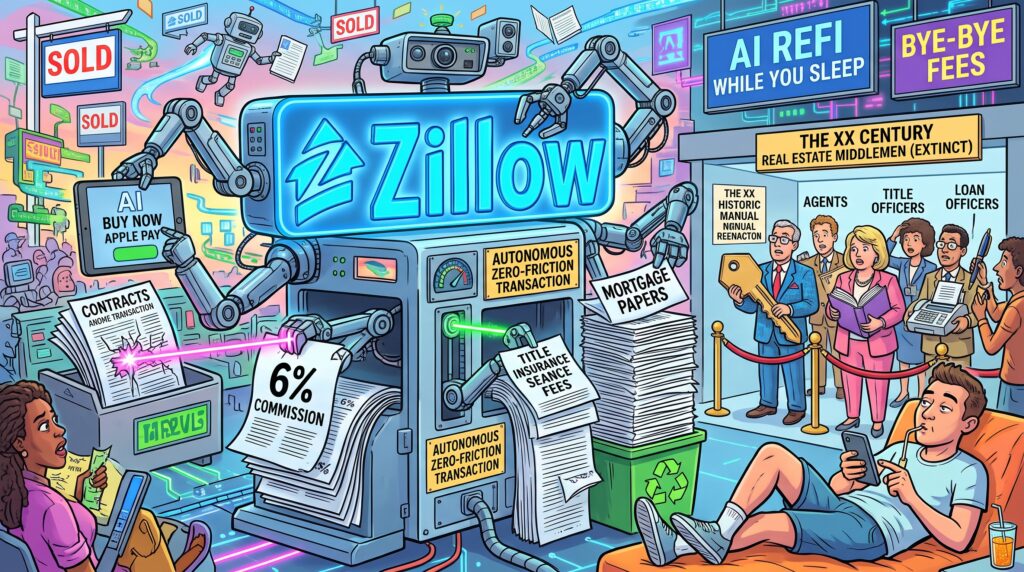
First, the sacred 6% commission is dead meat. The original essay confidently declares that few serious observers believe the human agent will be automated out of existence. That is adorable. The only reason we have been handing over $30,000 to $60,000 per transaction is that buyers were terrified of 40-page contracts and sellers were terrified of awkward conversations. Enter Agentic AI. Your AI doesn’t need a five-figure commission check to unlock a Supra lockbox, walk into a kitchen, point at a slab of stone, and whisper, “Quartz.” An AI agent can analyze 500 neighborhood comps in 0.3 seconds, spot the suspiciously fresh paint job hiding a foundation crack in the basement, draft a ruthless inspection contingency at 2:14 AM, and negotiate a $15,000 seller credit without ever once asking to take a photo of you holding a giant cardboard key. Human real estate agents won’t disappear entirely—they’ll just become an artisanal novelty, like hiring a bespoke butter churner or a Victorian town crier.
Second, title insurance is about to be exposed as the greatest medieval cosplay in modern finance. Right now, American homebuyers fork over thousands of dollars so a title company can perform a mystical séance over dusty county courthouse records from 1978, just to make sure the previous owner’s great-uncle didn’t accidentally deed the garage to a goat. It is a glorified database lookup masquerading as a blood oath, boasting a loss ratio lower than a carnival ring-toss game. An AI doesn’t need three weeks and a $3,500 closing fee to verify who owns a plot of dirt. It will ingest 150 years of municipal liens, probate filings, tax records, and easements, verify a crystal-clear chain of title, and underwrite the policy in the time it takes you to sneeze. The entire title industry is about to learn the hard way that its moat was actually just a puddle of unindexed PDFs.
Third, the mortgage bureaucracy is going to get vaporized. The essay shrugs off Zillow Home Loans growing 75% and 32% year-over-year, wondering how software can possibly change mortgages when macroeconomic interest rates run the show. Easy: by firing the army of human friction standing between you and the money. Today, getting a mortgage requires submitting 47 PDFs, two years of tax returns, a hair follicle, and a signed letter of explanation detailing why your college roommate Venmoed you $48 for “nacho emergency” in 2024. Billions of dollars in origination fees, junk fees, and rate-sheet padding exist solely to pay small cities of loan officers, processors, and underwriters to stare at spreadsheets and confirm you aren’t three raccoons in a trench coat. AI underwriting crushes origination costs to near zero and approves loans in four minutes flat. Better yet, autonomous AI mortgage agents won’t stop at closing—they will stalk the bond market 24/7 and automatically refinance your house while you sleep the exact millisecond rates dip 15 basis points.
Which brings us to the grand finale—the part the original essay nervously whispers at the very end, as if afraid to summon a demon: the day consumers ask “what company can help me buy or sell?” instead of “what person?”
Spoiler alert: that day already happened, and every single consumer on Earth already knows the answer is Zillow.
Go stop ten random people on the street and ask them what company would do the best job helping them buy or sell a house. Nobody is going to say a regional brokerage. Nobody is going to name a guy whose face is currently plastered on a bus bench. They are going to say Zillow—probably while already scrolling Zillow on their phone in the bathroom. The original essay frets that Zillow already reaches 215 million monthly users and has no new audience left to capture until annual home sales claw back above 5 million. Zillow doesn’t need more users. It already owns the entire country’s real estate brainspace!
Right now, Zillow is a sleeping giant politely monetizing itself like a glorified digital magazine for snooping on your neighbor’s hideous backsplash. The moment it stops playing nice with the legacy ecosystem and flips the switch to a full-stack AI transaction machine—bundling zero-friction AI brokerage, instant AI title, and autonomous AI mortgages behind one absurdly simple button—it doesn’t matter whether 3 million or 6 million homes sell a year. Zillow won’t be fighting for lead-gen scraps anymore; it will be vacuuming up the tens of billions of dollars currently incinerated on commissions, title searches, and mortgage bloat.
AI doesn’t need to 3D-print cheaper drywall or bribe the Federal Reserve to revolutionize real estate. It just needs to assassinate the middlemen and hand the keys to the one brand consumers already treat as the operating system of shelter. Buckle up—the giant cardboard key is headed for the museum.
Reminder: Read the original, true version, over on Crystal: AI’s Missing Real Estate Revolution. Or if you’re a founder or exec in GEM, you can read the original article here.


Sorry, the comment form is closed at this time.