
When Content Becomes Infinite, Humanity Becomes Scarce
I’m dating myself here, but there was a time when going to the movies felt relatively simple.
In the 1980s, the number of movies competing for our attention was a fraction of what we have access to today. You went to the theater, or you walked the aisles of Blockbuster. There were fewer choices, and because there were fewer choices, the good stuff had a way of finding you.
Then came cable. DVDs. On-demand. Streaming.
Today, we have access to more movies, television shows, documentaries and original programming than we could possibly consume in a lifetime.
And strangely, many of us still spend 20 minutes scrolling through Netflix saying:
“There’s nothing to watch.”
Of course, there is plenty to watch. There’s too much to watch.
That distinction matters.
And I think we’re about to experience the exact same phenomenon with business content because of artificial intelligence.
We Have Solved the Blank Page
AI has dramatically reduced the friction involved in creating content.
Need a blog post? Done.
A sales email? Here you go.
A presentation? Click, click. Bang, bang.
A LinkedIn post about leadership, complete with a compelling opening, three lessons and an inspirational conclusion?
You can probably have twelve of them before your coffee gets cold.
That is extraordinary.
It is also creating an entirely different problem.
When everyone can create content, creating content is no longer particularly valuable.
Finding something worth reading is.
We are moving from an era of content scarcity to an era of content abundance and perhaps eventually content overload.
It reminds me a lot of what happened to movies.
Streaming didn’t make great movies disappear. It buried them beneath an enormous amount of everything else.
AI isn’t going to eliminate great thinking.
It is going to surround great thinking with an almost infinite amount of perfectly acceptable thinking.
And that may be the bigger challenge.
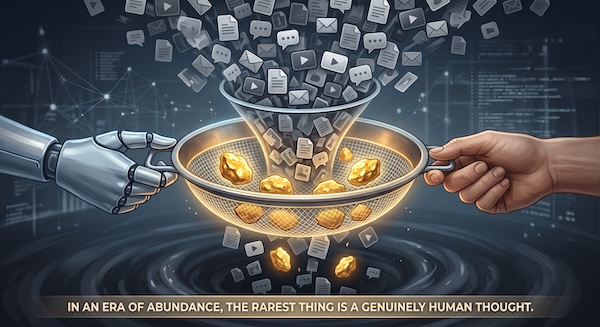
We’re Digging for Gold
The question increasingly won’t be, “Is this well written?”
AI can write well.
It can organize an argument, fix grammar, develop a narrative, summarize research and make mediocre ideas sound surprisingly sophisticated.
The more interesting question will be:
Is there anything here?
Is there an actual idea?
An experience?
A point of view?
Did someone learn something the hard way and decide to share it?
Did someone take a position that might make another person uncomfortable?
Did someone change their mind?
Did someone take time to be creative and connect with their audience?
Those are the nuggets we’re going to start digging for.
The human moments.
Perfect May Become a Warning Sign
There is another strange consequence to all of this.
For most of our professional lives, we’ve tried to make communication more polished.
Better grammar. Cleaner presentations. Tighter messaging. Perfectly constructed sentences.
AI can now provide all of that almost instantaneously.
Which means imperfection may actually become more interesting.
A strange turn of phrase.
A story that doesn’t fit neatly into five bullet points.
An opinion that isn’t perfectly balanced.
Humor that’s a little weird.
A personal experience that can’t be recreated simply by asking a model to “make this more insightful.”
These things have texture.
And texture is difficult to manufacture.
I don’t think the answer is to reject AI. Quite the opposite. I use it. Most businesses will use it. It is rapidly becoming another tool in the professional toolbox.
But there is an enormous difference between using AI to help communicate your thinking and asking AI to do your thinking for you.
One amplifies the human.
The other removes the human.
The New Scarcity
For years, companies competed on access to information.
Then information became ubiquitous.
We competed on the ability to create content.
Now content creation is becoming ubiquitous too.
So what becomes scarce?
Judgment.
Experience.
Curiosity.
Taste.
Perspective.
And perhaps most importantly, authenticity.
The person who has actually sat across the table from a struggling business owner has something AI doesn’t.
The salesperson who has lost the deal.
The entrepreneur who has missed payroll.
The executive who made the wrong hire.
The leader who had to tell a team something they desperately didn’t want to hear.
The person who changed their mind because reality proved them wrong.
Those experiences create something that can’t simply be prompted into existence.
Perspective.
Maybe the Future Is More Human, Not Less
There’s an understandable fear that AI will make business communication less human.
It certainly can.
But I wonder whether the opposite might ultimately happen.
When polished content becomes virtually unlimited, perhaps we’ll become much better at recognizing and valuing the things that are not.
The unexpected observation.
The uncomfortable admission.
The story without a perfect ending.
The idea that clearly came from someone who has actually been there.
Streaming gave us nearly unlimited entertainment, but it also turned discovery into part of the experience. We search, we ask friends, we read reviews, and every once in a while, we stumble across something genuinely great.
AI may do something similar to ideas.
There will be more content than ever before.
More articles.
More posts.
More presentations.
More “thought leadership.”
More perfectly written words competing for a finite amount of human attention.
Which means the opportunity isn’t simply to create more.
It’s to create something worth finding.
Because in a world overflowing with artificial content, the rarest and potentially most valuable thing in the room may simply be a genuinely human thought.


Sorry, the comment form is closed at this time.