
Smart Tech for the Full Resident Lifecycle
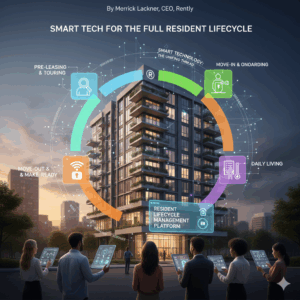
The growth of proptech has transformed the rental experience, yet many workflows still feel disjointed. Operators often juggle multiple systems for leasing, access, and maintenance. Residents encounter similar fragmentation as they move from touring to move-in and daily living. This disconnect has limited the full potential of smart technology, even as the industry has rapidly advanced.
The next phase of proptech focuses on integration. New advancements linking AI, hardware, and platform-level connections are closing long-standing gaps in the resident journey. Property managers gain the ability to operate more efficiently through unified tools that support every stage of engagement. Residents benefit from spaces that feel connected and intuitive the moment they arrive, with systems that recognize their needs and streamline daily interactions.
True smart living emerges when all these touchpoints work together as a single ecosystem powered by continuous data and thoughtful design.
The Operational and Resident Impact of Fragmented Workflows
Fragmented workflows create challenges that reach far beyond simple inconvenience. Property teams lose time switching between unrelated tools. Each system generates its own data, yet none of it connects in a way that supports informed decision-making. This leads to duplicated efforts, limited visibility, and slower response times during moments that shape the resident experience.
Residents feel the effects throughout their journey. A smooth self-guided tour can quickly give way to confusion during move-in when access permissions, device activation, and onboarding tasks happen in separate environments. Daily living becomes a cycle of jumping between apps to control access, request maintenance, or adjust smart home settings. These friction points influence overall satisfaction and can impact long-term retention.
Disconnected systems also restrict the ability of property teams to spot trends or anticipate needs. Without unified data, operators cannot easily track engagement, identify early signs of dissatisfaction, or analyze patterns that affect portfolio performance. Fragmentation limits the full value of proptech, even in communities with advanced devices and software. That’s why it’s time to shift to an approach that considers the full resident lifecycle.
Understanding the Full Resident Lifecycle
The concept of the full resident lifecycle captures every stage of engagement between residents and property operators. It includes:
- Pre-Leasing and Touring – Prospective residents discover listings, schedule self-guided tours, and qualify through digital screening tools.
- Move-In and Onboarding – Access credentials are created, digital keys distributed, and smart devices configured.
- Daily Living – Residents submit maintenance requests, adjust energy settings, and communicate with management through integrated apps.
- Move-Out and Make-Ready – Property managers can automatically revoke access to the lessee, while providing vendors and maintenance staff with their own unique access codes during the make-ready process.
In an ideal environment, data from each phase carries forward. Preferences and history follow the resident, informing how the property team interacts with them. This continuity transforms isolated moments into a cohesive experience.
Smart Technology as the Unifying Thread
Smart technology holds the key to connecting these touchpoints. When Internet of Things (IoT) devices, access systems, and management software communicate through a unified platform, the result is greater efficiency for property teams and more personalization for residents.
Automation enables properties to manage access while reducing staff workload. Integration ensures that actions taken during one stage, such as lease signing, automatically inform later interactions, like move-in scheduling or access permissions.
Personalization also becomes possible when systems share data responsibly. Budget and floorplan preferences can be remembered across leases, creating a sense of familiarity and comfort for residents while allowing operators to tailor experiences to individual needs. When smart systems operate in concert, it improves everything from security to convenience.
The Resident Lifecycle Management Platform
The idea of a Resident Lifecycle Management (RLM) platform captures this holistic approach. Rather than managing separate tools for leasing, access, and living, operators can use a single environment that connects each phase of residency.
An RLM platform brings together access control, communication, device management, and analytics in one place. Residents interact through an integrated app that manages everything from self-guided tours to smart locks. Property teams benefit from dashboards that display engagement metrics and energy data in real time.
This unified design builds on the evolution of self-guided touring and smart home automation, creating a foundation for complete lifecycle management. The outcome is a more seamless and sustainable resident experience, supported by continuous data flow and simplified operations.
What an Integrated Lifecycle Looks Like
Imagine a prospective resident discovering a community online and scheduling a self-guided tour through a digital platform. During the visit, sensors and access points authenticate identity and track engagement. When the lease is signed, new residents automatically get invited to their smart home app complete with access permissions and control of all the smart devices within their unit.
Upon move-in, the resident finds all smart devices already linked to their account. They can control access, temperature, and lighting from their phone. Maintenance teams receive automated access when needed, eliminating coordination delays. And property managers can manage all smart devices remotely.
This vision is already taking shape across forward-thinking portfolios. Early adopters report lower operational costs, higher satisfaction scores, and improved retention because every stage of the resident journey reinforces the next.
The Future of Resident Experience
The next generation of proptech will move from reactive to predictive experiences. AI will identify maintenance needs before breakdowns occur, while data insights will forecast renewal likelihood and energy use trends. Sustainability initiatives will grow as systems learn how to balance comfort with conservation.
Resident Lifecycle Management serves as the framework for these advancements. It unites devices, platforms, and analytics under the goal of creating communities that adapt intelligently to the people who live in them.
Smart living is evolving from a collection of gadgets into a coordinated ecosystem that supports residents and operators alike. By embracing lifecycle management, the proptech sector is redefining what it means to feel at home in a connected world.


Sorry, the comment form is closed at this time.